
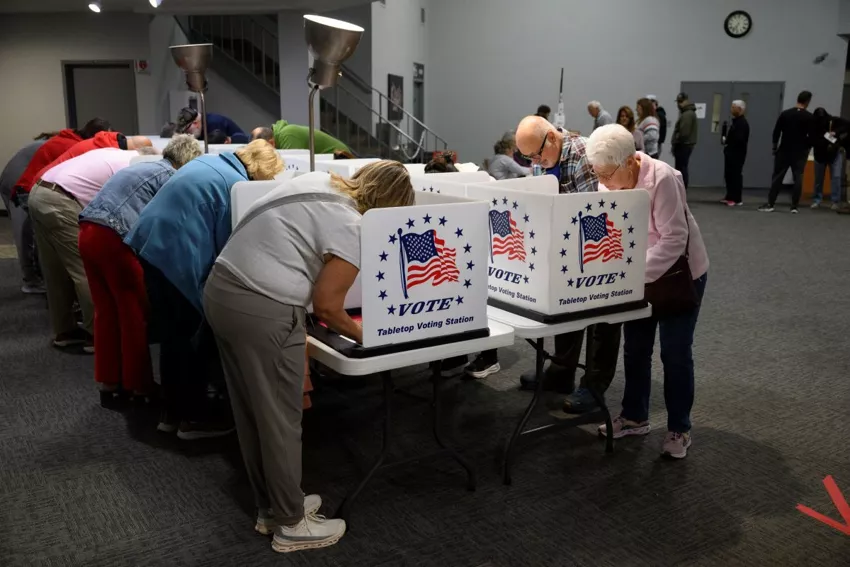
Counties with the highest percentages of Christians swung hardest to Democrats in the 2026 midterm elections, with political observers on both sides of the aisle criticizing Republicans' broken promises and messaging that ignored the struggles of families.
Are evangelical Christians moving Left?
Be informed, not misled.
A study by the progressive political organization Evangelicals for a Better Future compared 2024 presidential results with 2026 midterm results by county, finding that nearly every county moved left over the past two years, with the exceptions located primarily in Maine, Illinois, South Dakota, and Florida.
The 2026 midterm elections put Democrats in control of the U.S. House of Representatives and the U.S. Senate during the final two years of President Donald Trump's term. Unfinalized results show Democrats have picked up at least 42 seats in the U.S. House and at least eight seats in the U.S. Senate.
The study's main takeaway is that counties with the highest percentage of Christians collectively swung 20.5 percentage points to Democrats, while the least Christian counties moved 9.4 percentage points to the political left.
In most cases, the Democratic margin in the 2024 presidential election was compared with the margin of the Democratic U.S. Senate candidate in 2026. In states without a U.S. Senate race, the 2024 presidential margin was compared with the margin in the U.S. House race.
Why?
“This study demonstrates that Christian voters are increasingly swing voters,” Lee Scott, director of Evangelicals for a Better Future and a Presbyterian pastor, said in a statement shared with The Christian Post. “This isn’t about a re-emergence of the Christian left. It’s about the emergence of a truly Christian middle.”
Evangelicals for a Better Future contends the shift points to several factors, including Republican voters staying home, others voting for Democrats, and "Democratic-leaning evangelicals turning out after sitting out in 2024."
The organization points specifically to regions of the Bible Belt, such as Mississippi County, Arkansas, which moved 24.7 points toward Democrats. A 23.9-point shift was seen in Bristol, Virginia, and Anderson County, South Carolina, which the group calls "a striking erosion of Republican margins in evangelical strongholds."
Scott contends that Christian voters "aren’t beholden to a single party, and they sent a clear message rejecting the heresy of Christian nationalism.” He claimed that the results show “a clear sign that any party that takes their vote for granted or ignores the struggles of the families in their pews, does so at its own risk.”
While counties with the largest percentages of born-again or Evangelical voters may have swung left in 2026, exit polls in both 2024 and 2026 showed that 82% of white Evangelical Christians backed Republicans, while 17% supported Democrats. However, white Evangelicals or born-again voters made up only 17% of the electorate in 2026, down from 23% in 2024.
Among Protestants or other Christians, 63% voted for Trump in 2024, compared with 59% who supported Republicans in 2026. That group made up 43% of the electorate in 2024 and 40% in 2026. Trump received 59% of the Catholic vote in 2024, while 51% of Catholics voted for Democrats in 2026. The Catholic share of the electorate also shrank, from 21% to 20%.
By contrast, the nonreligious share of the electorate grew from 24% in 2024 to 27% in 2026.
The overwhelming majority of nonreligious voters backed Democrats in both 2024 (71%) and 2026 (79%).
An example: Starr County, Texas, swung hardest toward Democrats nationwide. The overwhelmingly Catholic county backed Trump by 16 percentage points in 2024 but supported Democrat James Talarico by more than 55 points in the 2026 U.S. Senate race. Eight of the 10 counties with the largest swings toward Democrats were majority-Catholic or plurality-Catholic counties in South Texas, with swings ranging from 71.8 percentage points in Starr County to 44.3 points in plurality-Catholic Cameron County.
Conservative grassroots leader Mark Meckler, president and founder of the Convention of States Project, pushed back on the notion that Christians, and Evangelicals in particular, moved to the left, suggesting the result was caused by low voter turnout among conservative Christians fed up with broken political promises on affordability and inflation.
“It’s important to remember that most Christians didn’t vote,” he said. “I’m an Evangelical Christian. We find it frustrating that generally 30 to 34% of Evangelical Christians vote.”
Meckler said Evangelicals and Christians “didn’t turn out because Republicans didn’t do what they promised to do.” He told CP that Republicans failed to follow through on their promises to “go after affordability” and identified Trump’s tariffs as a major factor in the election results.
Takeaway
As believers woke up on the morning of November 4 to the sweeping blue wave of the 2026 midterm results—two states enshrined abortion access in their constitutions, a first Muslim U.S. senator incorporated Arabic phrases of praise into his victory address, and a seminary graduate who affirms LGBT ideology, supports abortion, and rejects the exclusivity of Christ for salvation won a Texas Senate seat—they are left wondering: What now? Where’s the hope?
There is hope.
Tony Perkins, Franklin Graham, and other Christian leaders are leading the way.
For the Christian, the majority of these results appear nothing but bleak. And Perkins was quick to confess: “This is going to be hard to overcome.” However, his purpose in saying that was not to deepen the concern but to set up the counter. Despite the disappointing results, he emphasized, “Our hope and our focus must remain on God and His Word.”
Philippians 4:6 says, “Do not be anxious about anything, but in everything by prayer and supplication with thanksgiving let your requests be made known to God.” Jesus Himself warned of the troubles His followers would face so that Christians can have peace in the midst of the turmoil (John 16:33). Understanding this is crucial to the Christian’s resolve because, “we live in a fallen world and there’s going to be disappointment, but we don’t need to be overcome by that.”
“As the church, we need to keep our eyes upon the Ruler of rulers, appealing to heaven, [while] at the same time working to influence government,” Perkins said, “understanding that that influence comes from above and that we cannot place our hopes in the government of man or in the political process—even though we’re involved in it.”
The midterm results carry significant weight. But so does the call to keep our eyes fixed on the One who remains on the throne, Perkins said, to speak truth with clarity, and to labor for generational faithfulness rather than the next news cycle.
This election cycle should not change our involvement, he concluded. “If anything, it should increase our involvement.”
Be Informed. Be Discerning. Be Vigilant. Be Courageous. Be Engaged. Be Prayerful. Be Not Afraid.