

Retired Army Chaplain Brad Lewis got emotional this week when he heard War Sec. Pete Hegseth’s order to return the Chaplain Corps to actual religious ministry.
Hegseth said the Chaplain Corps' role has been “degraded” in recent decades, and he gave the example of the 2025 “Army Spiritual Fitness Guide” that mentions “God” once, but “playfulness” nine times in 112 pages.
Although most people in the military, 82 percent, are religious according to the guide, God has been nearly replaced by secular humanism. Hegseth eliminated the use of the guide this week and announced he is simplifying the faith coding system.
A Christmas gift to both the Chaplain Corps and those who serve our country in the military.
Be informed, not misled.
The Army is scrapping its Spiritual Fitness Guide after less than five months in use.
Defense Secretary Pete Hegseth announced the change in a video on social media on Tuesday. He largely addressed changes to the Army Chaplain Corps, in which he said that “chaplains have been minimized, viewed by many as therapists instead of ministers.” In his comments, he criticized the recently implemented tool, saying the Army is “tossing it.”
“It mentions God one time. That’s it,” Hegseth said. “It mentions feelings 11 times. It even mentions playfulness, whatever that is, nine times.”
Army spokesman Tony McCormick confirmed to Task & Purpose that the directive went into effect “immediately.”
“We are aggressively moving forward with Secretary Hegseth’s intent to discontinue the Army Spiritual Fitness Guide,” he said.
Hegseth is serious. The pages on the Army’s website that contained information on the guide and its related material have also been taken down, with the URLs redirecting to 404 error pages or other “not found” results.
Sec. Hegseth is restoring the history of God in America's military.
Chaplains are cheering Hegseth's leadership.
"The Chaplain Corps, formed by George Washington in 1775 to be the 'spiritual and moral backbone' of the military, Hegseth said. But chaplains say religion has been replaced by “spiritual fitness,” and they are often called on to be therapists more than religious leaders. Subtle culture changes have made it uncomfortable to speak of God’s word."
A current chaplain told The Federalist that he recently ended a memorial prayer, “In Jesus’ name,” and was verbally reprimanded for not keeping the prayer generic.
“That should not be what our chaplains face when they pray in accordance with their faith tradition.” He recalled a Muslim chaplain who prayed generically, not mentioning “Allah.” But the troops know their chaplain is Christian, Jew, or Muslim, so when they don’t name their God, the prayer rings hollow, and it makes the troops feel less safe speaking of their faith. Chaplains must work with all faiths, but that does not mean they should turn off their own faith. If they do, how can they say that faith guides their life or matters in a soldier’s life?
Lewis recalled a Christian chaplain who gave the annual suicide prevention talk and shared that he struggled with depression.
“He said, ‘I had some issues. My faith is what pulled me out of that. My relationship with Jesus.’ That’s all he said. He didn’t say, ‘You need to be saved. You need Jesus.’ He said, ‘This helped me immensely, and so if you have a faith, practice it. It’s good for you.’ He essentially lost his career for that,” Lewis said.
In 1944, General George Patton confronted constant rain that caused logistical problems for the troops. He asked Chaplain James O’Neill to pray and ask God to stop the rain. Patton had the prayer printed on 250,000 cards and distributed the prayer cards to all servicemen. The rain stopped in time.
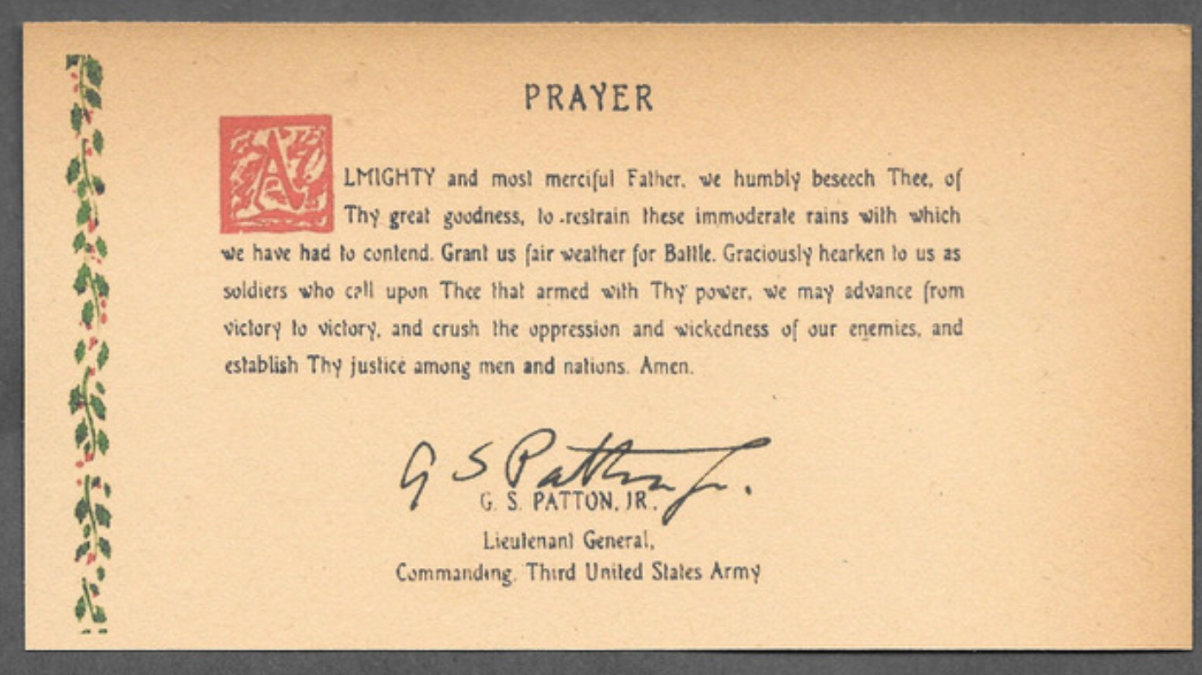
“The Army paid for it to be distributed during a time of war,” Lewis said. “Now, fast forward. We’re now at a place where I can’t mention Jesus in a suicide prevention brief.”
Lewis recalled to The Federalist, sitting in on briefings during a 2003 deployment, where pilots went over the mission before leaving the base. At the end, the commander stood up and offered a few words of encouragement. After a few briefings, Lewis suggested a prayer after the commander’s piece, and that became a tradition.
“Soldiers are hungry for the Word," he said. "I would find a scripture that talked about fighting, success, and about the Lord being with you if you’re with the Lord. And then I would pray, ‘God, be with them and protect them. Give them success. Confuse their enemy’… and the response to that from my soldiers was like, ‘Oh, my word, Chaplain, we need that so bad. Please keep doing that. Thank you for praying for us.’”
Evil recoils
The American Humanist Association recoiled at Hegseth’s directive, saying Hegseth “has no right to tell anyone what to believe or how to pray.” But that is not what Hegseth is doing; he is reasserting God’s role in the military — a role that, until recently, has been acknowledged since the inception of the Chaplain Corps.
“When you start to adopt a spiritual footing, instead of a religious footing, the chaplain becomes a psychologist. We start to look more like behavioral health,” Lewis said. Removing God leaves a chaplain with less to offer. He can say, “It’s going to be OK,” or give a little pep talk and tell them they will be fine.
But God is bigger than anything a soldier may face, and this offers hope.
Fish Stark, Executive Director of the American Humanist Association, and Ben Iten, President of The Humanist Society, the leading endorsement body for humanist chaplains, issued the following joint statement on Secretary of Defense Pete Hegseth’s comments about military chaplaincy: “Pete Hegseth has no right to tell anyone what to believe or how to pray," they say.
Hegseth’s broadside against the Army's Spiritual Fitness Guide – including putting scare quotes around “faith” traditions he doesn’t recognize or value – is an attack against any member of the military who doesn’t practice his form of conservative Christianity.
The Leftist, secular humanists, have been repeating those words since WWII. Even before.
Hegseth tries to hide this by attacking “secular humanism.” But the irony is that, despite the fact that certified humanist chaplains serve Americans every day in hospitals, prisons, and college campuses across the country, they are not allowed to serve in the military, they claim.
Every single member of our military, regardless of their religious beliefs – Christian, Jewish, Muslim, Buddhist, humanist, or anything else – deserves access to a chaplain who will support their well-being, the humanist claims.
"But it’s clear Hegseth doesn’t understand what this means," they say.
And oh, he understands. He just knows that there is somebody bigger than you and me overseeing a universe He Himself created.
He is the True and Living God.
Not a religion created by a man or a woman at some point in time. Who are now dead.
Takeaway
“Faith transcends immediate circumstances,” Lewis said. “When the chaplain brings God to the fight, he brings something bigger for the soldier to hold on to.”
When soldiers are in a combat zone with bullets flying and explosions going off, when they have to kill somebody, or their entire group is blown up by an IED, it changes them. To get through those moments and to cope with those experiences, it helps to lean on a God bigger than the universe.
When the chaplain uniform walks in, there is an expectation that this is a person of faith and they worship something transcendent, Lewis said.
“You offer them some comfort based on that thing that doesn’t move,” Lewis said. “Something bigger than all of this. ‘Yes, that guy died, and it was sad, it was tragic, but it’s going to be okay, because Jesus loves you and he’s in charge. God created the universe, and in his infinite wisdom, it’s time for that young boy to go home, and I don’t know why, and it hurts my heart, but it’s going to be okay. And with the strength that comes from having that anchor, let’s move on to the next guy and see if we can help him.’”
“An atheist can’t offer them that."
War Secretary Hegseth is not only a warrior himself, but he also understands God's role in the battle.
God's presence in battle isn't just physical; it is a promise of divine intervention, victory, and rest, as long as His people remain faithful and obedient, as in Joshua 21:44, where "the LORD delivered all their enemies into their hand."
Be Informed. Be Discerning. Be Vigilant. Be Bold. Be Faithful. Be Prayerful.