
 Print
Print  PDF
PDF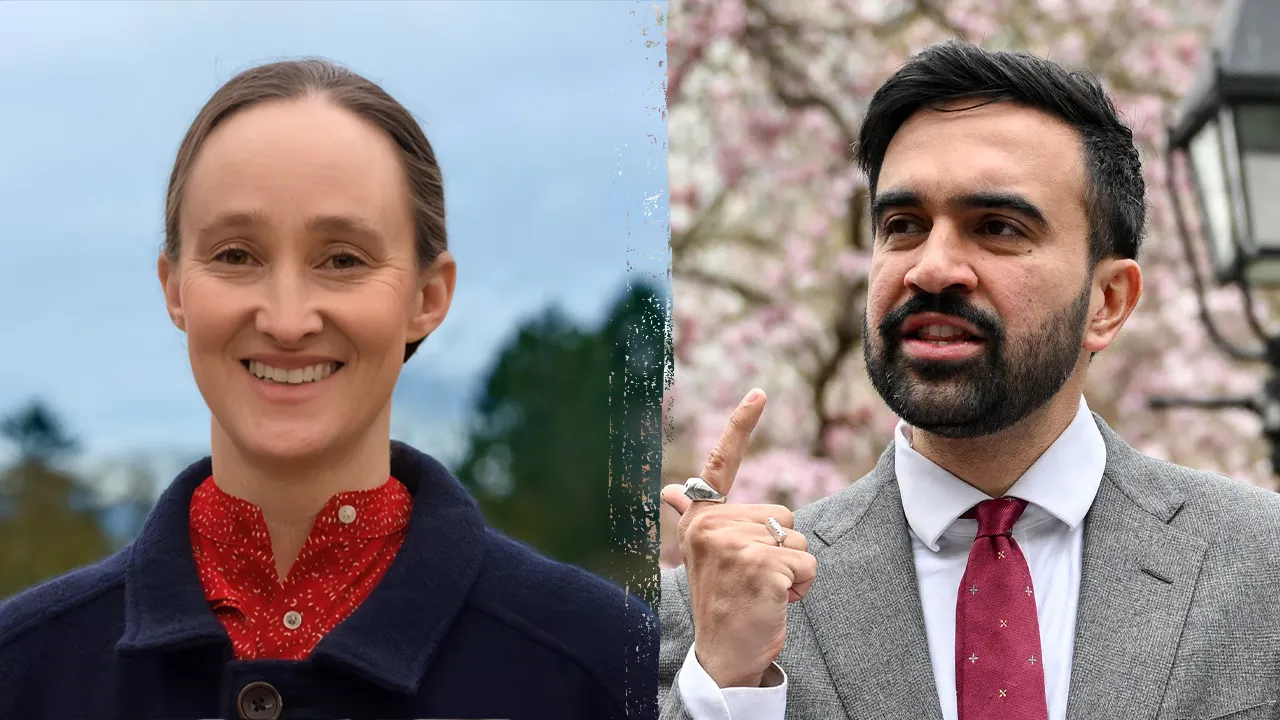
As people in Seattle and New York City listen to the rhetoric of their newly elected socialist mayors, they are beginning to ask, "What's the difference between socialism and Cultural Marxism?"
Socialism is Marxism.
A growing number of people living in these cities are also asking, "What have we done?"
In their quest for Truth, they are turning to Artificial Intelligence.
Welcome to the New World of AI.
What is Cultural Marxism?
Be informed, not misled.
Got questions? Ask AI.
I did. Here's what AI is telling millions of people:
In simple terms, "Cultural Marxism" is often used as a far-right conspiracy theory claiming that Marxist thinkers, particularly from the Frankfurt School, orchestrated a long-term plot to corrupt Western culture, undermine traditional values (like family, religion, and nation), and promote progressive ideas like identity politics, political correctness, and multiculturalism to destroy society from within, though academics distinguish this from genuine Marxist cultural analysis. While some academics use related terms for analyzing culture, the conspiracy theory falsely portrays these ideas as a deliberate, subversive plot, often carrying antisemitic undertones by linking them to Jewish intellectuals.
"Got Questions," a Christian-based publication, had this to say:
Cultural Marxism can be a controversial term—some assert there’s no such thing, and others use the term as a catch-all for anything they see as undermining society. In short, cultural Marxism is a revolutionary leftist idea that traditional culture is the source of oppression in the modern world. Cultural Marxism is often linked to an insistence upon political correctness, multiculturalism, and perpetual attacks on the foundations of culture: the nuclear family, marriage, patriotism, traditional morality, law and order, etc. Cultural Marxists are assumed to be committed to establishing economic Marxism, in which case their cultural attacks are a necessary preparation for their ultimate goal.
Beyond question, there is a purposeful effort in parts of Western culture to reject traditional values and aggressively replace them with more so-called progressive ideals. For instance, derogatory attitudes toward men, whites, Christians, fathers, heterosexuals, and so forth are often celebrated or encouraged.
For Christians, dealing with cultural Marxism involves a spiritual dimension. It is undeniable that, in the West, Christian values are under attack.
Takeaway
To gain a fuller understanding of Karl Marx and his brother, Cultural Marxism, we must look to history.
1. Marx’s philosophy was predicted by Aristotle: “Revolutions in democracies are generally caused by the intemperance of demagogues, who either in their private capacity lay information against rich men until they compel them to combine (for a common danger unites even the bitterest enemies), or coming forward in public stir up the people against them.”
2. Marx’s father, Heinrich (who changed his name from Hirschel), was a German Jew who converted to Lutheranism in order to advance his legal career. Heinrich had Karl baptized in the Lutheran Evangelical Church when he was six years old, a faith the young Marx ostensibly possessed during his teenage years. When he was only 17, Karl Marx wrote an essay called “On the Union of the Faithful with Christ according to John XV.” In that essay, Marx wrote that humanity’s “heart, reason, intelligence, history all summon us with loud and convincing voice to the knowledge that union with [Christ] is absolutely necessary, that without Him we would be unable to fulfill our purpose, that without Him we would be rejected by God, and that only He can redeem us.”
3. Karl Marx, at some point in his life, rebelled against God and His Word. And apparently against his father's beliefs.
4. In 1914, twenty years after Marx died, Goethe University was founded in Frankfurt, Germany. A few years later, the University opened a new Institute dedicated to preserving Marx’s legacy–The Institute for Social Research. Goethe University itself describes the Institute as follows:
Founded in 1923 with funds from patrons Hermann and Felix Weil as an institute for academic Marxism, with Max Horkheimer the IfS became the central research centre for critical theory. In the spring of 1933, the institute was closed by the Gestapo because of ‘subversive activities’. Via circuitous routes, it managed to move to Columbia University in New York and continue its work in exile. After the war, the institute’s closest circle – Adorno, Horkheimer and Pollock – returned to Frankfurt, and in 1951 the IfS was re-established at its present location.
The Institute describes its “interdisciplinary program” as the “Frankfurt School,” which “evolved away from orthodox Marxism toward social criticism grounded in social philosophy.” Although the Frankfurt School, as well as other neo-Marxist European institutions, were somewhat ideologically stratified, the term “Cultural Marxism” is not contrived by the theory’s opponents.
For instance, one of the current leading scholars on cultural Marxism today is UCLA Professor Douglas Kellner, acclaimed for his research in critical theory. In his essay Cultural Marxism and Cultural Studies, Kellner chronicles Marx’s significant influence on Neo-Marxist scholars through the twentieth century. University of Arizona historian Dennis Dworkin, who specializes in neo-Marxist cultural theory, published an entire book entitled Cultural Marxism in Postwar Britain.
5. Like Marx, Antonio Gramsci accepted history as a class struggle between an oppressor and an oppressed. However, Gramsci diverged from Marx’s call for violent revolution because of its inefficacy. Gramsci argued that neo-Marxists must first occupy major cultural institutions through a “war of position” to defeat the influence of capitalism and religion. In a 1916 article for a socialist newspaper, Gramsci made clear that socialism must wage cultural war against its opposite, Christianity:
The article said, "Socialism is precisely the religion that must kill Christianity. Religion in the sense that it too is a faith, that it has its mystics and its practitioners; religion, because it replaced the transcendent God of the Catholics in our consciences with the trust in man and his best efforts as the only spiritual reality. Our gospel is a modern philosophy, dear friends, one that dispenses with the hypothesis of God in the vision of the universe, one that lays its foundations only in history, a history in which we are the creatures of the past and the creators of the future… Ours is not a doctrine of slaves in revolt; it is a doctrine of rulers who, in their daily toil, prepare their weapons for domination of the world."
6. Marxism was the proximate philosophical cause for insurrection, famine, persecution, and even the threat of nuclear war during the twentieth century. Its consequences were so disastrous that some Christian leaders rightly observed it as a form of spiritual warfare.
7. Billy Graham called the conflict a “battle to the death,” where either Christianity or Marxism would die. “The name of this present-day religion is Communism… The Devil is their god, Marx their prophet, Lenin their saint, and Malenkov their high priest. Denying their faith in all ideologies, except their religion of revolution, these diabolically-inspired men seek in devious and various ways to convert a peaceful world to their doctrine of death and destruction.”
8. If Billy Graham was correct about the spiritual reality of Marxism, then the stage for the next spiritual battle lies in the Western World, namely America. If the American Church truly faces the threat of a newly awakened ideological leviathan, then it must revive its cultural opposition to Marxism and its progeny.
It's time for Christians and their pastors to speak Truth to the culture.
We cannot give away our culture to Muslims, and we must not give it away to cultural Marxists.
God help us.
Be Informed. Be Discerning. Be Vigilant. Be Engaged. Be Bold. Be Prayerful.
