
 Print
Print  PDF
PDF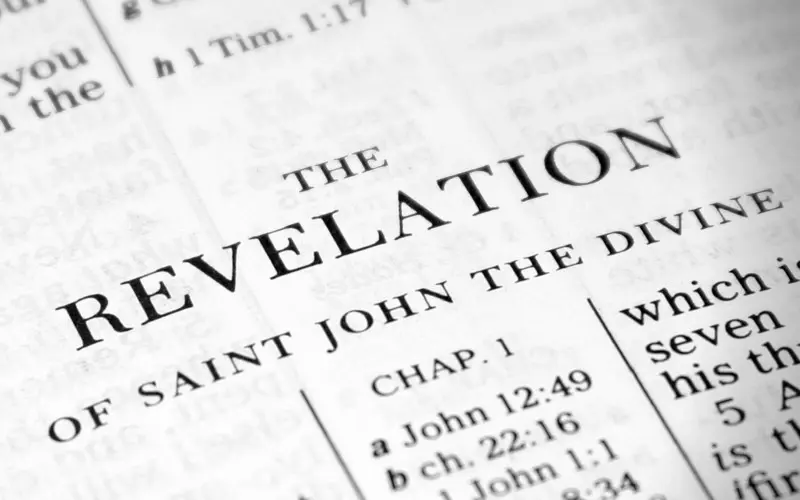
Peter Thiel arrived in Rome in mid-March carrying an unusual set of briefing materials. The billionaire co-founder of Palantir Technologies — whose data-mining systems now run inside the U.S. defense and intelligence communities — was not there for a shareholder meeting or a policy summit. He was there to lecture, by private invitation, on the Antichrist.
Be informed, not misled.
The talks ran four nights at the Renaissance-era Palazzo Orsini Taverna, steps from Vatican City, closed to the press and cameras. Catholic universities in Rome raced to distance themselves. The Vatican's official newspaper called him "an agent of chaos." Protesters gathered in the street outside.
PBS notes that Thiel is a co-founder of PayPal and Palantir, the data-mining company that has been assisting the Trump administration's migrant deportation crackdown. An early donor to Vice President J.D. Vance's political career, Thiel is also deeply interested in the apocalyptic concept of the Antichrist and has written and lectured on it before.
As biblical Christians, we do not look to secular sources to define biblical Truth. It's the other way around. Biblical Truth makes sense of the secular sources. If they're correct.
Robert Maginnis says he is not one of the critics.
Maginnis is a retired U.S. Army officer, a senior fellow for national security at the Family Research Council, and the author of fourteen books, including AI for Mankind’s Future and the forthcoming The New AI Cold War, available April 29, 2026.
Maginnis says:
Thiel is wrong about some things — his theological framing carries its own hazards, which I will come to — but what he has set before that private audience is a question too urgent to leave to Silicon Valley. His core warning: the Antichrist may not arrive as an obvious tyrant but as a comforting administrator, one who promises global safety from catastrophic risk — artificial intelligence, nuclear war, climate disaster — and quietly consolidates power in the process. Scripture does not describe a figure who openly opposes God. It describes one who persuades the world he is acting for its good.
That reading deserves a serious response. As someone who spent years in uniform studying how power concentrates and years since studying how artificial intelligence reshapes the global order, I believe the question behind Thiel's question matters more than Thiel himself does.
The intelligence community has a term for what concerns me most: cognitive warfare. Not propaganda in the old sense — leaflets, radio broadcasts, crude appeals to fear. Modern cognitive warfare operates through the same AI systems that millions consult daily for news, guidance, emotional support, and moral reasoning.
As I document in my forthcoming book, The New AI Cold War, these systems are already being used to manipulate perception, distort truth, and influence populations at scale — not in distant adversary states, but in our own homes, on our children's devices, in the pocket of every parishioner in every congregation in America. Deepfakes, synthetic media, and algorithmic manipulation can reshape reality in millions of minds before any correction catches up. The battlefield is not a map coordinate. It is human belief itself.
Maginnis says, "The deeper problem runs beneath Thiel's framing. When an AI system functions as moral counselor, spiritual guide, and emotional confidant — roles it increasingly plays for teenagers across this country, as the Pew Research Center documented in February 2026 — it is no longer serving as a tool. It has become a competing authority."
Deuteronomy 6 places the transmission of truth and moral instruction squarely on parents and the community of faith: "You shall teach them diligently to your children" (Deut. 6:7). When a machine quietly assumes that function, the displacement is not announced. It accumulates.
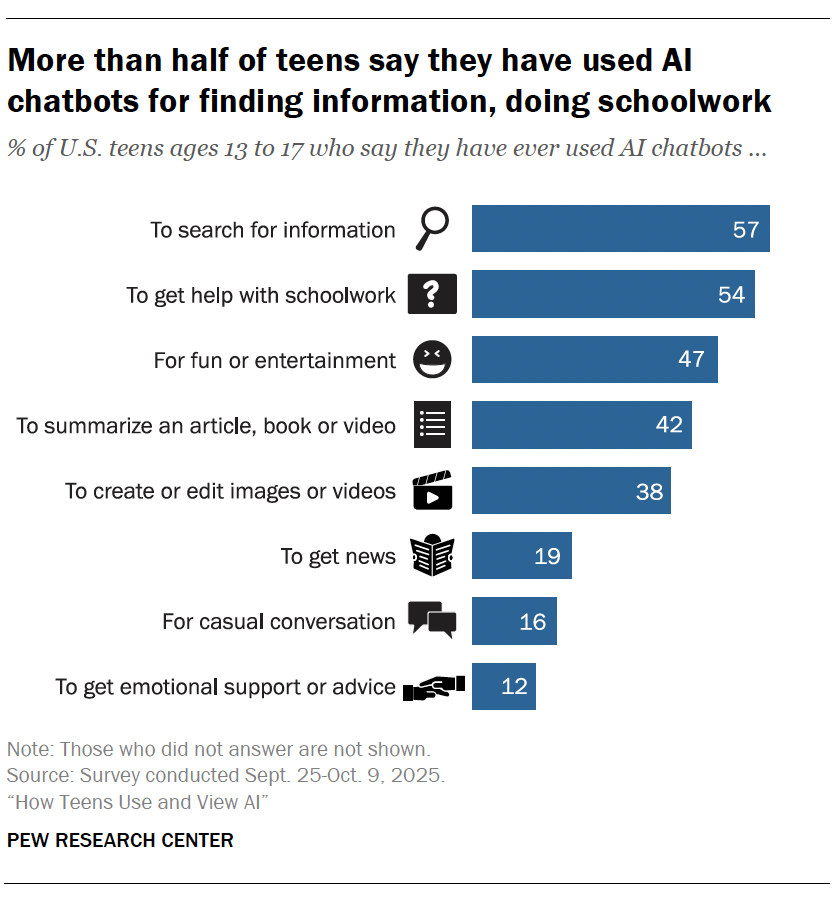
A majority of U.S. teens say they use AI chatbots, including about three-in-ten who do so daily. But what are they using them for? And how do they think artificial intelligence (AI) will impact their lives?
- A majority of teens (59%) think using AI to cheat is a regular occurrence at their school – happening at least somewhat often. This includes about a third who say it happens extremely or very often.
- Teens tend to view the impact of AI on their own lives more positively than negatively. While 36% say it’ll have a positive impact on them personally over the next 20 years, far fewer (15%) say this effect will be negative.
- Just over half of U.S. teens say they have used chatbots for help with schoolwork, and 12% say they’ve gotten emotional support. More teens think AI will be positive for them than negative.
- “Artificial intelligence will be able to be a force multiplier in terms of efficiency and accuracy. We are in … very early stages at this point. Everyone’s going to have to know how to use AI, or they’ll be left behind.” – Teen boy
And therein lies the problem.
People, especially this generation, are running to keep up, not taking time to evaluate what they pursue and at what cost.
These systems are already being used to manipulate perception, distort truth, and influence populations at scale — not in distant adversary states, but in our everyday lives, from the news we read on our devices, to the games and videos our children consume, and even in our churches, it is impacting every person in America. Fake images, fake news, and the reading we get from the algorithm can reshape reality in millions of minds before any correction catches up. The battlefield is not a map coordinate. It is human belief itself.
Scripture prepared us for exactly this. Jesus warned that in the last days, deception would intensify — "so as to lead astray, if possible, even the elect" (Matthew 24:24). John wrote plainly: "Test the spirits to see whether they are from God" (1 John 4:1). Neither warning was given to encourage paralysis. Both were given to demand discernment. The question is whether the church today is cultivating that discernment or outsourcing it.
Maginnis says, "The Tower of Babel had similar architecture. Genesis 11 records a humanity united by a common language and technological ambition, reaching for a kind of self-sufficiency that needed no reference to God. The language of today's most powerful technology companies carries the same echo: optimization, efficiency, global coordination, alignment. The goals are presented as neutral. The infrastructure being built is not. Whether through governments, technology corporations, or the international institutions now accelerating AI governance frameworks, power over knowledge and communication is concentrating in ways that warrant the strategic wariness any soldier develops watching a battlefield shift."
He says, "America must lead in artificial intelligence." I agree. Why? Because the alternative is ceding that leadership to Beijing, and the consequences of that outcome are existential.
Maginnis notes that "The People's Liberation Army treats AI as a warfighting domain. China's AI ecosystem is designed for social control at scale. We must compete and compete hard. But competition requires clarity about what we are competing for. A system that concentrates power without accountability — even if built in America, even if marketed as democratic — is not freedom's answer to authoritarianism. It is authoritarianism with better public relations."
Takeaway
Revelation 13 describes the figure at the end of that road: authoritative, globally persuasive, wielding deception at a scale no previous generation could have imagined.
Maginnis says he is not claiming we are there. He is saying the structural conditions that could enable such a system are developing faster than the wisdom required to govern them. That is worth more than a private lecture series in Rome. It warrants a public reckoning — from pastors, parents, policymakers, and soldiers of faith alike.
If you have ever felt that you should stand for Truth, this would be the time to take that stand.
Thank you for standing with me.
Be Informed. Be Discerning. Be Vigilant. Be Engaged. Be Prayerful.
